This transcript was generated automatically and may contain errors.
Laura Giles: Hi, I'm Laura Giles. I'm an educator and a board member for the Yale Center For Faith and Culture, and a fellow listener. This podcast is just part of the wonderful work that the Center does to create a more just and flourishing society in a world that seems increasingly fragmented and polarized. The center creates points of connection between people who might otherwise seem to be.
Quite different. But by asking the right questions and listening the team behind this work creates a realm of mutual understanding that I believe is critical. Please consider supporting this work by making a generous December donation at faith.Yale.edu/give. Your generosity is invaluable to this work that I believe is knitting our culture back together.
Evan Rosa: This episode was made possible in part by the support of the Tyde House Foundation. For more information, visit Tyndale.Foundation from the Yale Center For Faith and Culture. This is for the life of the world. A podcast about seeking and living a life worthy of our humanity.
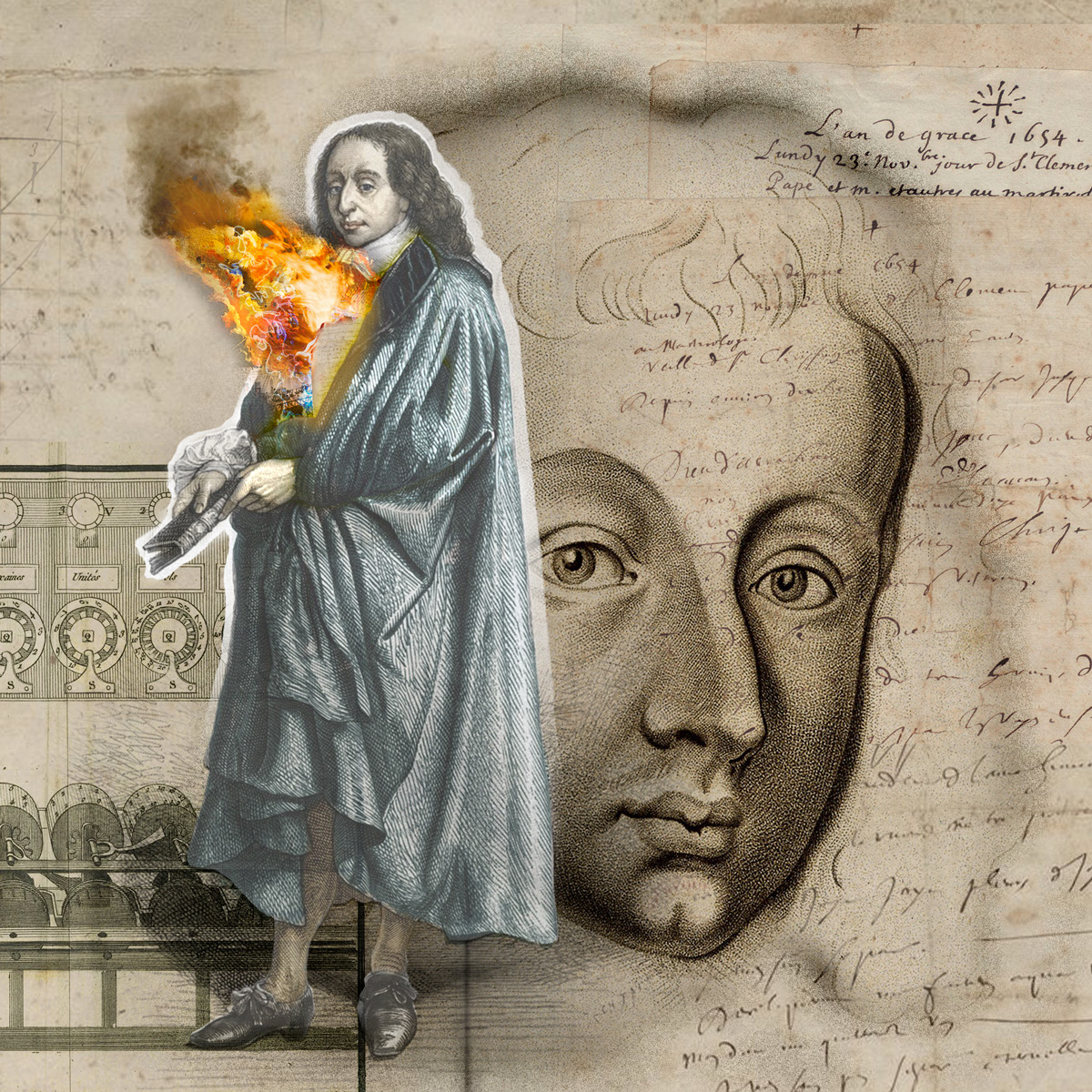
Graham Tomlin: The Year of Grace, 1654. Monday, 23rd of November, and then he goes through the dates. You know the saints that are remarked on that.
Evan Rosa: This is Graham Tomlin, author of a recent intellectual and spiritual biography of a modern man of both mystery in mechanics, Blaise Pascal.
Graham Tomlin: Right at the heart of this powerful experience of God that he has in 1654 in the Night of Fire, there's a line that's really significant, says that
the greatness of the human soul.
Evan Rosa: Blaise Pascal was a member of the 17th century Catholic spiritual movement. Jansenism offering a radically different approach to faith and reason than his French contemporaries, Descartes and Monta.
Graham Tomlin: He's a very conscious of the greatness of the human soul, but he's also conscious of the, the kinda weakness of the human soul.
At the same time, our capacity to be distracted by things that really don't matter that much. The fact we don't think about the things that really do matter that much. The fact that we're actually constantly in competition with one another. He says, you know, all men naturally hate each other, and that's our kind of natural state.
We're always in competition with other people.
Evan Rosa: The author of Ponce, these philosophical fragments gathered and collected after his death. Pascal's influences reverberated throughout the rest of modernity in both thought and technology. Friedrich Nietzsche said if Pascal that quote, his blood runs through my veins and Pascal's early calculating machine paved the way at the very technology you're using.
To listen to me right now.
Graham Tomlin: And so he's very conscious of both greatness and misery. And so I think that's, that's the context of the Night of Fire. There's a kinda restlessness in his soul this struggling between the two.
Evan Rosa: But what of this mysterious night of fire that Gram Tomlin is introducing to us here, the story about it reveals.
A quiet depth of soul, a radically private, but radically transformative experience Pascal held onto beyond even his dying breath.
Graham Tomlin: Well, we don't really know a great deal about it, largely because he never mentioned it during his lifetime, and it didn't mention it to anybody, even his family. The only reason we know about it was because after he died, one of the servants who was preparing his body for burial cut open his his jacket.
And felt something in the lining of the jacket and opened it up and pulled it out. And there were two sheets of paper with uh, two very similar accounts of what was clearly one experience on a particular evening in late November 60 54, with the word foot fire at the top. And of course, and then the precise dating of it and the time, you know, between half past 10 at night and half past midnight, two hours it lasted.
And then this kind of poem that describes this night of fire, this, this experience of divine presence and this sense of God coming near to him, experience of joy, of
Evan Rosa: certainty. Just imagine being the one to discover this, to hear that Russell of paper in the Dead Man's code to pull out a journal entry and read the words that.
Just as well might have remained unknown. Uh, and then he
Graham Tomlin: goes on to, um. I say this God of Abraham, God of Isaac, God of Jacob, not of the philosophers, but the learn it certitude, certitude, feeling joy, peace God of Jesus Christ, my God and your God. Your God will be my God. He is only found in the ways taught in the gospel grandeur of the human soul, righteous Father, the world has not known you, but I have known you.
Joy, joy, joy, tears of joy. I've separated myself from him. They have forsaken me. The foun of living water. My God, will you leave me? Let me not be separated from him forever. This is eternal life that they know you. The one true God, and the one that you sent. Jesus Christ. Jesus Christ. Jesus Christ. I left him.
I fled him. Renounced him. Crucified him. Let me never be separated from him. He is only kept securely by the way he's taught in the gospel. Renunciation, total and sweet, complete submission to Jesus Christ and to my director. Eternally. Enjoy for a day's exercise on the earth. May I not forget your words.
Amen.
Evan Rosa: Too often in this life, we're forced to separate the person from the work, the private, from the public. Or maybe this separation is too infrequent and Pascal offers a disciplined reminder of the gift of one's private life. But this record, this meditation was found and surely a discovery such as this has a way of.
Backwards coloring everything prior to it, demanding a new appreciation for the secret and central element of a person's being and doing in the world.
Graham Tomlin: One of the things that strikes you about, it's the predominance of the figure of Jesus Christ in it. I think there's, you can parallel Descartes goes into a room on his own and comes out with the theory of rationalism.
You know, I think therefore I am. Um, and he has this idea of God as the first idea that the thinking self perceives outside itself, which kind of guarantees the rest of the system, if you like, but it's a kind of rubber remote God. It's a distant God. There's no mention of Jesus Christ in this. Pascals is very different.
Pascals is the discovery of the God of Jesus Christ, the God of Abraham, Isaac, and Jacobs, not the God of the philosophers. And that's the phrase, a very famous phrase of Pascal, not the God of the black, not the God of Descartes. This is not the God that I'm talking about here. This is a God who passionately desires human devotion that can connote 'cause the only one who can satisfy human longings, the only one that can bring true happiness.
And that's a big theme for Pascal. And so for him, I think he, he had found this sense of security, of certainty, of not, not a rational security, but a kind of spiritual and psychological security certainty. He found a sense of real joy in that moment, and it did issue an a whole different way of life for him.
Evan Rosa: The right Reverend, Dr. Graham Tomlin is president of St. Malitus College and Director of the Center for Cultural Witness, where he edits the online magazine scene and unseen. He's the author of many books and he's taught historical theology at Oxford University and was bishop of Kinsington in the Church of England from 2015 to 2022.
He joined me recently to discuss how to read Blaise Pascal, how to understand his philosophical and cultural insights, the keen spiritual perception, and the courageous commitment to life between greatness and misery. These wonderful things that Pascal left behind his brilliant and brief life. The conversation brings Pascal into a vivid contemporary focus, Pascal's illness, his genius, the struggle between intellectual achievement and his devotion to his faith, the ways he was caught between Descartes, rationalism and Monte's skepticism, a careful examination of the human proclivity to self-deception, distraction, longing, and desire.
The limits of our reason, our obligations to the poor and the limits of our finite minds. The result being a kind of fire that both illuminance and burns in our hyper-rational, hyper distracted age. Thanks for listening today, Graham, thanks so much for joining me on for the life of the World.
Graham Tomlin: Evan, it's great to be with you today and looking forward to the conversations.
Evan Rosa: Absolutely. Blace Pascal is a phenomenal figure in the history of philosophy, but really I would say in modern history period, I mean the way that he had his fingers and his mind in so many spaces for the time he was so innovative and so original, and yet didn't publish anything during his lifetime. I wonder if you can just give us a little bit of background about what you think is so interesting about Pascal.
Graham Tomlin: I mean, he is, he is, as you say, a fascinating figure, partly because he touches on so many different aspects of life that kind of matter to us today, that why he's particularly of interest to people in our world in that, you know, you think of so many of the things that we normally do in a bio routine.
You know, we have insurance policies, which are all based on probability, and Pasco was right at the beginning of the formation of Probability Theory with Pierre Deir. At Fairmont's last theorem, he was one of the first people in Europe to wear his timepiece on his wrist or as opposed to in his pocket.
So when you wear a wristwatch, you think of Pascal. He invented one of the very first calculating machines, which is often thought of as a precursor of the modern calculator and computer. So every time you open a laptop or. Send an email. You kind of think of Pascal. So he was a scientist, he was an entrepreneur, he was a kind of visionary, he was a philosopher, he was a theologian.
He was a real polymath. And there aren't many people like that today who have their fingers on so many different aspects of human life. And I think that's why I find him so fascinating as a person and why he appeals to a very wide range of people, not just theologians or philosophers or scientists or mathematicians, but all of those people because of the influence he had on those different fields of life.
Today, he died young. 39. Yeah, he was born in 1623. Just over 400 years ago in a town called Claremont, I mean, which is in the, which is in the sort of south middle of France. And he died, uh, in 1662. So literally he never saw his 40th birthday. So he had a very shore life, but an extraordinarily productive life.
He was also a life full of sickness and illness. He once said that he didn't have a day in his adult life where you didn't experience some kind of sickness or pain. He died probably of sort of stomach cancer, which had secondaries in the brain. He had intense headaches towards the end of his life who had a really bad stomach pain, and he was the kind of person who to take his mind off the pain, would engage in some kind of mathematical puzzle that he would try to work out.
And some ways the pain was quite productive for him, both intellectually and spiritually at the same time. So yeah, it's a very short life and an extraordinary productive one at the same time, both in terms of its scientific work, but also its philosophical and theological work as well. How would you introduce his
Evan Rosa: spirituality and his religious background?
Graham Tomlin: Well, he was, he was born into a fairly conventional Catholic family in 17th century France. And you think of the 17th century, it's, it's, it's actually, I think, quite a key period in the development of European life. You know, you've got the 16th century reformation, which had left behind all kinds of. Sort of fractures and fissures in European life, and he's right at the heart of those.
And the 17th century was really a time where in response to the Protestant Reformation, the Catholic Church in some ways was kinda refining himself and a whole number of sort of spiritual movements in the 17th century. And he was kind of caught up with many of those to say he was born into a fairly conventional Catholic family.
His mother died when he was about three or four years old, so he doesn't really remember his mother very much. His father was a kind of intellectual involved in the scientific and philosophical discussions of the day, but not. Particularly spiritually engaged, but the family became quite involved in a movement known as Jansenism, uh, which again, was very controversially.
It was a kind of extreme, kind of Augustinian, um, an intense form of spirituality and fence, discipline of prayer based on an Augustinian understanding of humanity, that we are sort of deeply fallen and flawed and that only grace can release us and can change us from within. The human effort doesn't really get us very far with that.
Pascal's family was drawn to the Janssen. It's partly because his father, one day. Was on his way to act as the second to a dual, which was slightly controversial. They were meant to be outlawed at the time, but on his way, he fell over and dislocated his hip, and so he got these bone setters in. This is what you did.
You got bone setters in to kinda help manipulate the bones. Anyway, these bone setters turned out to be jansenists and they were invited into the family to live with them for a while, and their aim was not just physical. Reparation of the family, the spiritual reformation. So they preach their Jansenist doctrine and they deeply owned, particularly Pascal's sister, his younger sister, Jacqueline, but also Pascal himself.
They recognized that here within Blaise. Pascal at the time, as someone in his teenage years, was a precocious, bright young man. They had intensified their efforts on him, so he found himself drawn to Jansenist from this extreme form of spirituality of Augustinian spirituality. But he always had a bit of a struggle between the call to the life of the scientist.
The mathematician and he engaged in some very significant scientific experiments during his day, for which he became quite famous to the pull of the world in that sense. But then the pull of God and the church on the other side, and the way Janssen, his spirituality set it up was it was very much either or, you were either in the world or you were devoted to God.
And Pascal, I think always struggled with that sense of, you know, how does he carry on his. Philosophical, some mathematical work. At the same time, be an intense Christian, and I think part of the resolution of that was on a particular night in November, 1654 where he had this powerful experience of the presence of God, which is sometimes called his night of fire, which helped to resolve something of that and issued in a more devoted Christian life from that point onwards.
Again, we could talk about more about that, but that's just a bit of a summary of.
Evan Rosa: I think we should get to the night of fire, but I would like to think a little bit more about his philosophical and theological roots. And so when you think about the principles or the dialectic that he was a part of knowing Descartes and being part of basically an early modern philosophical period, we've touched on Jansenism, but I don't know if we've fully explored the other philosophical or theological commitments or simply contexts that we would need to appreciate in order to truly understand Pascal.
Graham Tomlin: I think there, there are two broad strands that you have to kind of get your mind around to understand Pascal and the way he positions himself philosophically and theologically. One is, as you say, the tradition. The Descartes was part of that early kinda modern rationalism that newfound confidence and human reason and its capacity to understand the world Descartes' method of doubting everything until you could find something that you can be absolutely sure of, which of course he.
Is the thinking self. And so for him, this idea of, you know, I think therefore I'm called gto, ergo, the idea that, you know, we, our own self-consciousness is the kind of center of reality. And that bred in, not just in Decart, but in many of his contemporaries, a real excitement about the possibility of rebuilding the world on the basis of human reason.
The human reason can understand everything, but the mind and the body are separate things. Actually the body doesn't really matter that much. It's the mind that matters. So that's one strand of is extreme confidence in human reason. The other strand, I think that's really important for Pascal and, and just on Dekar, I mean, Pascal and Dekar did actually meet on two occasions over the same weekend.
Decart was a little bit older than Pascal. They came to visit him. He was really disparaging, a bit patronizing at this young upstart figure that, uh, people had sort of told him was a great genius and they, I didn't like anybody else who was the genius to be in his company. 'cause he thought he was the only one.
And so they didn't get on very well. And actually at the time when they met Pascal was, was quite ill. And Decart lectured him on how he should get better. Not a good bedside manner, putting it that way. So there's the Descartes strand, but then the other science strand is the sort of skeptical strand of philosophy, particularly in French Monte.
Exactly. So Montana of course is from a century before 16th century. Figo very prominent in sort of French thinking of the time, and Monta represents that skeptical tradition. But actually most of what we think we know is sheer custom. It's fairly random. And Monta has a faith, he has a sort of distant kind of faith in God.
He's a Catholic, he does. Renounced that he's a believer in God, but actually God doesn't appear very much in his philosophy. Jesus Christ certainly doesn't appear very much in the essays, which is the great text of Monte. And in some ways, that's what Dekar and Monte have in common for Pascal, that neither of 'em really take God that seriously.
They kind of have God as a. Cart of the system that kind of guarantees some sense of order within the world, but they're not really that interested in God. Whereas Pascal is very interested in God. And so Pascal places himself between these new strands of philosophical life, the rationalism of Decart and the skepticism of Monte.
And I think that makes it very contemporary for us because he places himself in this context where we too have the kind of modern rationalists, the kind of Richard Dawkins types of this world who think they can understand everything by the means of science and by the means of kind of rational inquiry.
We also have the kind of postmodern project. To KU and Deida and everybody else, which are kind of profoundly skeptical about our capacity to know truth, anything to be ultimately true. Also aware of the kind of, the situatedness, the randomness of much of what we claim to be objective, very conscious of the subjective nature of things.
So Pascal is, is is very much in that territory between skepticism and rationalism, between modernism and postmodernism, if you like, and offering something of a Christian critique of both.
Evan Rosa: You see? At one point in the book that really the only way to make sense of this, I believe, is to understand it through the Augustinian framework. I wonder if you could comment in light of those contemporary influences on Pascal and his truly contemporary relevance to us today in our period. How does that.
Augustinian framework draw things together in your opinion.
Graham Tomlin: One of the key things that Pascal often says is he talks about these two things. He talks about, uh, in French. It's, it's the, the greatness and the misery of humanity. And he talks a great deal about the, the kind of complexity of humanity, the complexity of human experience, the fact that it's not simple, it's not straightforward.
It's I one nor the other. We have this incredible capacity to know things in the world. He's very, he liked. Decart. He is very confident in the scientific method. He thinks that science can understand. He's very different in his approach to science than Decart. He's very much an experimental scientist as opposed to a kind of theoretical scientist, but he's very confident in science in that sense.
He thinks that we human beings have this extraordinary capacity to understand the world. We have extraordinary ability to love one another, to care for one another. We are able to create remarkable things. We have this greatness of soul. In fact, right at the heart of even the Night of Fire, this powerful experience of God that he has in 1654, there's a line that's really significant.
Am human, the, the lamp human, the greatness of the human soul. He's a very conscious of the greatness of the human soul, but he's also conscious of the, the kinda weakness of the human soul. At the same time, our capacity to be distracted by things that really don't matter that much. The fact that we don't think about the things that really do matter that much.
The fact that we have a, we're actually constantly competition with one another. We, you know, all men naturally hate each other, and that's our kind of natural state. We're always in competition with other people, and so he's very conscious of both greatness and misery. By that deeply Augustinian idea and a very simple idea in many ways.
He says, well, how do you cope? How do you make sense of this strange mix that is humanity, the, the greatness and the refuse of the universe? That's what we are, we're the greatest thing and all the worst thing in the universe. How do you make sense of this? And he said, the only thing that makes sense of it.
Is not one or the other. Not the kind of emphasis on the greatness that Descartes or they've got weakness you yet in 10. But the deeply scriptural and Augustinian idea that we are both created, gloriously created, but also deeply and radically fallen. And that explained both of those things. And so what he is offering there is not a kind halfway house between the two, but a grander theory that explains and encompasses both that can make sense of both.
And so he says to take art and the rationalists. Yeah. You know, you have. You know, there is a structure to the universe that can be explored and we have the capacity to explore that. But at the same time, a lot of what we do know, a lot of our laws, a lot of our politics are pretty random, to be honest.
They're not objectively based in nature, even though there is an objective structure within nature
Evan Rosa: customary and socially, I mean, to some extent, I, I'm, I'm curious, uh, if you would think he goes so far as social construction.
Graham Tomlin: To a certain degree he does. I mean, there's a chapter in the book on Pascal's politics, which was real issue for him because during the time of the 17th century when Pascal was alive, it was coming outta the 30 years war, this war that had convulsed Europe and led to the death of vast numbers of people across Europe.
At the time in France there was a think called the formed, which was a kinda rebellion against monarchical power. They can increasing power of the royal court. Pascal always. He was quite conservative politically in some ways, but ultimately I think his conclusion on politics is he calls it rules for a madhouse.
He's full of so many good quips. He's just one of the wittiest writers. Exactly. That's right. And so actually, you know, his, his view of politics is it's not based in some sort of objective world. Actually's, a limited amount that politicians could do politics, it can provide rules for the madhouse. They can't change the madhouse.
Only grace and only God can do that.
Evan Rosa: Yeah. In so far as that's true, in that view of human nature is true, both great and fallen, how would you describe his view on the structure of society and what he thinks is the proper way that the people ought to go about relating to one another in the public sphere?
Graham Tomlin: I mean, as I say, when he spoke about the fa this rebellion, he was not in favor of it at all. He actually tends to say, well, yes, he's in favor in some ways of a kinda limited form of monarchy. He thinks it's better than aristocracy. It's better than, certainly better than chaos and anarchy. It's even better than democracy in some ways.
He's not a great fan of public opinion 'cause he thinks that most people just think about stuff and get it wrong most of the time. So he actually thinks the best political arrangement is a kind of genial and godly monarch in some way. But his approach to, and he does, to talk about the way in which. Laws are simply to be random from one place to another.
He talks about or can be right on one side of, of a river and wrong on the other side of the river, depending on whether it's in one country or the other, because laws differ from one place to another. He's very conscious of the kinda random and customary nature of our legal structures, and that's something he gets from Mon has a similar sort of.
Me a skepticism about, not that he thinks that we don't need law, not that he thinks we don't need politics, but he just thinks that there's a limit to what they can do. And I think this is what goes to the heart of the sort of philosophy and theology of it. I said a moment ago that he says, see, you know, all men naturally hate each other.
He actually says at one point, if everybody knew what everybody else said about them, there would not be four friends left in the world. It's a kind of social experiment. Think about all the things you say about the people you know and your friends and if they knew those things, what they would, they would feel about it.
'cause we all, and he says, you know, we all talk about other people behind their backs and we don't say things to their face. But in fact, people knew it would be pretty catastrophic in terms of our relationships. And that's because his analysis of the human condition is that it. Deeply and radically self-centered, which is why he actually talks in, in very, quite a, quite arresting and quite to us offensive terms about how important it is to hate yourself.
Yes. He talks about the hatred of the self and the swear. That's very, very star language for us. It's. Terrible, you know, 'cause of course we tell ourselves all the time, it's important to love yourself and to, um, and to be yourself and to, you know, to care for yourself and to kind of value yourself and everything else.
Now he, he, he talked in a very different way from that because he thinks the love of self is the very thing that pits us against one another and makes us into competition with one another. And that actually enables us. It makes it obviously possible for us to know God and it's only God and grace that can unlock that love of self and can begin to turn it around where you begin to actually almost despise yourself and begin to love God himself.
Love God instead. Now that's it's kind of difficult language for us, but it's kind of important for Pascal and it's not uncommon to other people, right? Hate the same sort of time. And so that's, I think what he feels in terms of our social relations, that he thinks it's being aware of that natural self-centeredness that we have.
He ultimately thinks only grace can begin to turn that around, but he thinks that politics has a value in putting rules for the madhouse to make sure that that self-centeredness does not get too destructive within our cultural and political life.
Evan Rosa: What is his view of the self that we ought to hate in order to do this kind of corrective on our natural bias toward ourselves?
Graham Tomlin: Yeah, it's a good question because there's a strong tradition in Christian faith about talking about the self and the divided self, you know, so Paul talks about putting on the new self and the old self, and so he sort of sees a kind of division within the self, the new Christian self, the old. Sinful self and so on.
Now, basal uses that kind of language to talk about the self. There is a point, there are points at which he does talk about the importance of caring for oneself and loving oneself, and so it's not entirely about hatred of the self. I think what he means by the self that needs to be hated. It's that it's that self that wants to organize everything around me, that part of my makeup, my psychological, my spiritual makeup that thinks everybody.
I basically ought to think that I'm wonderful and basically organizes my own life and priorities around my own. It's that self, that competitive self, that self that wants to seize everybody else as a competition.
Evan Rosa: It sounds like the, like the Nietzschean self, like the one that struggles constantly as a will to power
Graham Tomlin: over the other.
Yeah, exactly. That's right. It is. And Nietzche and Pa, you know, Nietzche had a very interesting relationship with Pascal. He, he kinda loved him and he hated him at the same time. Um, he was very drawn to Pascal, thought he was one of the great humans in history. He ate his Christianity 'cause what he thought, what he did to Pascal.
But that's a whole other story. Wait, wait. Whitney Nie thought Christianity did to Pascal. Yeah, he said, I can, I can never forgive Christianity for what it did to Pascal. He was drawn to him as a person 'cause he did sort of understand Pascal's soul, which. It's a, it's a, is a, is a, you know, quite a compelling person when you just listen to him and you read him and you, you think, here's someone who, who really understands what it is to be human and has all kinds of perceptive insights into the nature of the human condition, which I think Nietzche could realize.
But he felt that, that Christianity had kind of corrupted pascal's soul and had made it very kind of in know dark and, and. Drawn to this self hatred as it as it were. I said, you know, Nietzsche's idea that we're gonna evolve into the Superman, that Uba, mensch Pascal is none of that at all. He doesn't think we're gonna evolve into that whatsoever because it's precisely that self that's the problem, that self, that places itself over against everybody else.
And I think the other thing about it is that the deceptive self, because he actually thinks that the self is constantly deceiving itself all the time.
Evan Rosa: I think this has been really interesting because there's a sort of history of reflection on self-deception and the meaning of it, you know, uh, all the way from the cave and earlier, uh, all the way to Freud, the way that this is a precursor to modern psychological understandings of who we are.
Graham Tomlin: Yeah, yeah. No, exactly right. And I think Pascal is one of the deep reflectors upon the nature of the human self within the conditions of modernity. I think that's exactly what he does. In fact, I, I was reading over the summer this a really interesting book via French philosopher Pier Manno and on Pascal's challenge to modern atheism and indifference.
And he talks about it in this way. He says, you know, the, the self is this irresistible bias towards self from which no human being can escape. You know, we, we want to be loved, we want to be esteemed. We want to be the object of the attention of other human beings, and we cannot not want this. So he's very aware of the Augustinian sort of bias in our nature and our inability to stop doing it.
And that's again, one of the key things about Pascal's spirituality, psychology, anthropology, that he's deeply augustinian in the sense that he thinks that our longings are much more powerful than our logic. Our desires are stronger than our reason, which is one of the reasons why he's not that keen on Descartes.
It's why it's one of the reasons why he's not very convinced that all the kind of apologetic reasons Christians give to kind of why you should believe in God. That really worked that well.
Evan Rosa: Yeah. There's a passage on page 3 54. I'd love for you to read it if
Graham Tomlin: you have the book handy. Yeah. Paragraph goes like this, at the heart of Pascal's, diagnosis of the fallen human condition is self-deception.
We hide the truth about ourselves and present instead of fiction, a false picture of ourselves to others. What results in polite society is a rad all be well of each other, wanting to win the affection of others, yet no one tells the uncomfortable truth. This is why he writes Each rung of fortune's ladder, which brings us up in the world, takes us further from the truth.
Because people are more wary of offending those whose friendship is most useful and enmity most dangerous.
Evan Rosa: How, how do we understand the kind of bleak outlook there? Does he have any social hope? And, and if so, where does that come from, given. This innate orientation toward hatred of the other, and well, a suggestion to hit the prideful self perhaps. Where's the social hope?
Graham Tomlin: Yeah, I mean, just before getting onto that, it's worth just, I think taking that paragraph and.
Putting it into the contemporary context. And I think that speaks very powerfully to a lot of the ways sort of social media and algorithms work today. You know, we present an image of ourselves to the world, which is different from the person who is behind that image. And the last thing we do in public is to kind of present what is really going on inside our own parts and our, all the doubts and the jealousies and the kind of fears and the anxieties.
Neuroses. We don't project those in public and we project the image that we want people to see. And so I think that's very close to what Pascal's talking about in terms of the deceived self and the deceived and deceiving self. So is there any social hope in this? He, he is not primarily a politician.
He's not someone who is seeking to kind of build a political system, as I say. Skeptical about the extent that politics can bring, but he does. He does have a real sense of hope and it, and it ultimately, it's not a bleak vision of of life. It can't seem like that. In fact, tan Goldman, who is a sort of Marxist philosopher in the last century, wrote a book on Pascal.
He talked about, you know, Pascal's sad theology. Pascal's tragic vision, and that's ultimately, I don't think it is a tragic vision. I think it is a, a sad theology. Pascal never thought sort of it as a sad theology because he was actually filled with, with hope for the capacity of grace to overpower that self.
That if you do open yourself to the presence and reality of God, which is kind of what he did on that night in 60 54, there is a possibility of radical. Turning away from that sense of the self being at the center of everything. And you know, two of the things that came out of that experience for him, one was a desire to enable other people to discover that sense of joy and certainty and conviction that he'd found on that night.
And, you know, he talks about, you know, tears, tears of joy. This is a joyful thing for him and which is what, what results in the Paul say his attempts to show other people that true happiness is to be found in God, not in any of the substitutes for God that we put forward. Um, but on the other hand, he finds himself drawn to the poor, to drawn to poverty.
And one of the things that mark his life from that point onwards is this real conviction. But he should be giving his life to the poor of Paris. And Francis is a very sort of socially stratified society. So he thinks that divine grace has this capacity to displace the self and instead implant in us the desire for God that enables us not only if you like to overcome that self-oriented nature in our lives, but actually to give ourselves to those who are less advantages than ourselves.
And so if you, you know, if you think of the way in which Pascal worked that out the rest of his life, I think it's fascinating. Um, so I think that's the kind of social hope he has. It's not in the political system as such, but it is in the power of grace to be able to unlock that, um, self-oriented mentality.
And anthropology,
Evan Rosa: the way you characterize that unlocking is the first effect of grace is a kind of deep dissatisfaction. Distaste for the normal pleasures of life so that a longing emerges. And you can sense Augustine in this as well. So I think this is a good point to talk about the night of fire.
It's such a remarkable thing to have, you know, uh, such a spiritual experience. I'd love to hear your telling of the story and its significance in how we should understand PAs.
Graham Tomlin: Well, I think a lot of the background to it is this tension that I've talked about earlier on of these two pulls in Pascal's Life Once Awards the kind of public life of a public intellectual mathematician, physicist.
The one thing he was known for in his life was a serious experiments that he did on the, the existence of the vacuum and the weight of air, which went around Europe. It went viral. It was a pretty big deal. And you know, he was a celebrated figure. People knew about Pascal. He was kind of famous in many ways.
There was that pull, but then there was also the pull of the Jansenist spirituality that said, no, no, you must turn your bet. You, you are back on the world and give yourself a tiny to God. And I think he, he always struggled to work out how you'd hold these two things together. And in the period just before this 1654, there's a period both where he is.
And he's in the salons of Paris meeting all the kind of famous people and engaging, witty conversation. And he was very witty. He was very, you know, he had a great turn of phrase as he were saying earlier on. Um, but at the same time there was a kinda restlessness in the heart. His sister had recently joined this convent of poal, which is the center of Jansenist devotion in Paris, and then had a sort of house towards the, the western of Paris as well.
And he would visit and hear these sermons. And so he was kind of pulled in these two directions. And so I think that's, that's the context of the night of five. A restlessness in his soul, this struggling between the two, but we don't really know a great deal about it, largely because he never mentioned it during his lifetime.
The only reason we know about it was because after he died, and it didn't mention to anybody, even his family. After he died, one of his, one of the servants who was preparing his body for burial cut open his his jacket and felt something in the lining of the jacket and opened it up and pulled it out.
And there were two sheets of paper with a two very similar accounts of what was clearly one experience on a particular evening in late November 60 54, with the word foot fire at the top. Across and then a precise dating of it. And the time, you know, between half pasts, 10 at night and half past midnight, two hours it lasted.
And then this kind of poem that describes this night of fire, this, this experience of divine presence and this sense of God coming near to him, experience of joy, of certainty. Uh, one of the things that strikes you about, it's the predominance of the figure of Jesus Christ in it. I think there's, you can parallel.
Decart goes into a room on his own and comes out with the theory of rationalism. You know, I think therefore I am. Um, and he has this idea of God as the first idea that the thinking self perceives outside itself, which kind of guarantees the rest of the system, if you like, but it's a kind of rubber remote God.
It's a distant God. There's no mention of Jesus Christ in this. Pascals is very different. Pascal is the discovery of the God of Jesus Christ, the God of Abraham, Isaac, and Jacob, not the God of the philosophers. And that's the phrase, a very famous phrase of Pascal, not the God of the, not the God of Descartes.
This is not the God that I'm talking about here. This is a God who passionately desires, human devotion that can connote because the only one who can satisfy a human. The only one that can bring true happiness. And that's a big theme for Pascal. And so for him, I think he, he had found this sense of security, of certainty, of not, not a rational security, but a kind of spiritual and psychological security certainty.
He'd found a sense of real joy in that moment. And it did issue an whole different way of life for him. He engaged a bit more with the poor Al community. Now, he didn't entirely leave behind his scientific experiments. He did continue with those and with his mathematical work, but it did take a bit of a secondary place.
So I think what what actually happened was not a, a sort of turning his entire back on the world. Finding the right place for his scientific and mathematical, um, explorations. I think he felt more comfortable with the place that they had in his life from that point onwards. And as I say, what it led to is both this intense preoccupation with the poor and what he could do to alleviate poverty in France at the time.
And then with this attempt to try to convince his skeptical, you know, sophisticated friends who are all still in the salons having their witty conversations. How he could convince them that their true happiness was gonna be found in God, not in the substitutes for God that they pursued all the time.
Evan Rosa: I mean, what's, what's amazing is we have the text and the, the actual, the record itself in his own writing, and you included in the book, it would be wonderful to hear you read it and then to consider its impact and then you know, what it might suggest to us.
Yeah. So it starts at the top with, um, this is over a period of like two hours, right? Yeah. It's a, it's such a particular point. It refers to a, a moment. Like an exact moment.
Graham Tomlin: It does, it does exactly. It said, you know, um, year of Grace, 1654, Monday, 23rd of November. And then he goes through the dates, you know, the saints that are remarked on that particular day.
Uh, and then he goes on to, um, say this God of Abraham, God of Isaac, god of Jacob, not of the philosophers, but the learn it certitude, certitude, feeling joy, peace. God of Jesus Christ, my God and your God, your God will be my God. He is only found in the ways taught in the gospel grandeur of the human soul, righteous Father, the world has not known you, but I have known you.
Joy, joy, joy, tears of joy. I've separated myself from him. They have forsaken me. The found of living water. My God, will you leave me? Let me not be separated from him forever. This is eternal life so they know you, the one true God, and the one that you sent. Jesus Christ, Jesus Christ. Jesus Christ. I left him.
I fled him, renounced him, crucified him. Let me never be separated from him. He is only kept securely by the way. He's taught in the gospel, renunciation, total and sweet, complete submission to Jesus Christ and to my director eternally. Enjoy for a day's exercise on the earth. May I not forget your words.
Laura Giles: Amen.
So
Graham Tomlin: you can sort of sense the emotion in that. And there's a mixture of sort of scriptural reference of his own personal kind of experience and how he describes this. Um, there's a sense of, my God will be your God, which is a kind of reference I think to the Jansenists, his Jansenist friends who say I'm in part of this movement now.
And one of the things that comes out of that is the great opponents of the Janssen for the Jesuits at the time. And um, there was a kinda big struggle going on between the Jansenists and the Jesuits Jesuit. Were trying to get the Jansenists Jansenism sort of Lord as a heresy, Pascal gets engaged with that.
And one of the signs of Pascal's genius is that the great Jansenist leader at the time onto an I know had been writing very long. Involved theological treaties is trying to kind of defend their position. He wasn't getting very far at all. He was losing the argument and one point desperation, they turned to Pascal and said, you are young, can't you do anything?
And so Pascal comes at it from a completely different angle and uh, he writes the provincial letters, which is basically comedy. It's humor and he takes the Jesuits arm, not in a sort of full frontal theological argument, but just by poking fun at them. And it was brilliant. And they went viral. They actually didn't quite win the argument 'cause the Jesuits were too powerful to do that.
But you know, he's put himself in with the Janssen. Now there's a, he's an very interesting relationship with Janssen is, I don't think ultimately he was. Completely a janist all the way along the line. He had significant differences with them in a number of different ways, but he's invested in them. He wants to take their side, you know, they just, that that line at the end, the eternal joy for one day's exercise on the earth, a promise of eternal life.
That's a big thing for him. And that kinda recalls the idea of the wager, which he comes onto it a bit later on as well. So yeah, it's a very powerful moment for him.
Evan Rosa: I think the wager is the classic text that an introduction to philosophy would have you read of Pascal and yet, I don't think it's the most interesting thing that he wrote, but what do you make of Pascal's famous wager and the role it might have played in his own
Graham Tomlin: life?
I think it's commonly misunderstood as an argument the way people normally set up The argument is that, that it's basically Pascal rationalizing and saying, well, you might as well bet on God because you've not got a lot to lose, but you got a lot to gain. And people have accused that argument of all kinds of different things.
They would say, well, there's the many God objections. Well, it doesn't necessarily prove Christianity. You could use that argument for the God of Islam or a Judaism or uh, Hinduism or whatever it might be. There's the argument that it's very kind of an objective. You'll know there's no skin in the game, there's no kind of personal engagement with it.
It sounds like it's very self-interested. It's all about, you know, my own personal advantage. Well, you know, I stand to gain quite a lot. They like buying a lottery ticket. Uh, that doesn't sound a very religious argument. And in some ways those criticisms have a certain degree of merit. But I actually, I don't think that Pascal was trying to put an argument to strong arm people into belief in God.
So I guess the way I read the argument is it goes like this and I think it would've played a key role in his apology for Christianity as let me, readers may know. Listeners may know. He set himself the task of writing a great apology for Christianity. He never finished it, but he wrote down notes, which were gonna go towards this work.
And the notes were found when he died and those friends published them as the poe, the thoughts of Mr. Pascal and religion of other subjects. And so scholars had great fun trying to work out what the final thing would've been like, what order they would've come in and everything else. I think the wager would've played a key, key role in it, because I think what he's trying to do is a key role, but a limited role because I think what, what he does in the wager is he says, I think he would've come in the course of a conversation.
He often did that. The provincial letters are a kind of series of letters written to a friend out in the provinces. He seemed to like that literary device of kind of conversation letters to people, and I think it would've been like that. And so he's talking to someone who has been on a bit of a spiritual journey.
Is at the point where they're kind of interested in, in God, in Christianity, but they're not already convinced. And you know, this person says, well, you know what? What do I do? There's reasons to believe in God. There's reasons not to believe in God. God seems to be true in some ways, but other times he doesn't seem to be true, which I guess is a lot of people's experience.
And the guy says, well, you know, do I have to decide? And Pascal says, well, there is a coin being tossed at the far edge of the universe. It's gonna come down heads or tails. God exists so God doesn't heaven or hell, which are you gonna go for? And the guy says, well, do I have to bet? Pasco said, well, you do have to bet because you're already bet.
You are either living your life as if God exists or you're living your life as if God doesn't exist. So you've already made a commitment just by being in the body. We've already kind of taken sides, and so the guy then says, well, is there any evidence one way or the other? Pascal says, well, there is, but it's not enough to convince.
Um, and he says there is, there are good reasons for believing. It's not that he's a total fit aist, he doesn't think there are no rational reasons for believing in God, but neither does he think they're psychologically powerful enough to convince people, and he thinks there are all kinds of other things that you might come up with to say that actually God may not exist.
So he says, well, you know, reason cannot help you in this. So the guy says, well, what, what do I do? And that's the point at which Pascal says, well, let's do some probability. Now, think about this for a moment, because Pascal had already done a lot of work on probability theory in a sort of secular environment, and he says, let's do the probability of this.
Because in some ways he, he'd already done some work on a particular problem of probability in mathematics, which is all about gambling game. A, one of his friends were gamblers and someone, one of them once said to him, you know, there's a problem for that. Um, what about if, you know, if you start a game of cards or a game of sort of tossing coins and people will bet on the outcome on one side or the other, the game gets interrupted halfway through and you can't finish it.
How do you allocate stake? And, um, Pascal and Fair Amount work out a way of doing that, you know, probable outcomes. And he says, okay, well life's a bit like that. You know, there is this coin being tossed at the ridge of the universe. The game is not yet over. Don't know. Where that's gonna go. So let's do the probability on it.
And he says, okay, well if you believe that God does exist, let's work out the probability there. If God does exist, and you are right, you stand to gain quite a lot. But if you are wrong, you don't actually lose that much. Maybe a little bit of sacrifice within this life, but that's only a short, short thing If you bet God doesn't exist and you are right, well, you've gained a great deal, few pleasures for a few years in this life, but not much.
But you stand to lose a great deal if you are wrong. And so he says, if you are super purely. Being rational about it. If you're simply doing the probability, you'd always bet on God. 'cause you stand to gain a great deal, but you're not gonna lose much. Whereas if you bet against God, you stand to gain, not very much, but you stand to lose a great deal.
And so the guy then comes back and says, um, okay, well I kind of get this, but I can't make myself. Believe something that I just don't feel, I don't believe at which Paul Point, Pascal says, yeah, I get that. I kinda get that point. But that's when the key line comes in. Pascal says, well, at least get it into your head that the reason you cannot believe is not because of your reason, it's because of your passions.
Now, that I think is the key point of the wager. What he is trying to get at is not strong arming people into belief in God, but he's saying that if you were really being rational about it, if you are really doing the. Probability, always bet on God. The reason you don't is not because of your reason. It's not because of your logic.
It's because ultimately there's something in you that just doesn't want to submit, doesn't want to admit this.
Evan Rosa: Such an interesting read because of the way that it's basically just sets up a, a counterpoint. It just puts unbelief into a sharper relief. Like the reasons for unbelief, which aren't reasons perhaps. I would love to hear you connect it to habit because it also seems like, well, yeah, I understand that, but just get on with it.
You said, uh, I'm quoting you. Suspend your doubts for a while. Act as if it is true, a bit like a programmed machine, if that is in fact the path to real faith. It's just such an interesting way that it anticipates obviously like all the contemporary obsession with habit building and an improvement. Uh, it's really, again, wonderfully interesting and prescient.
Graham Tomlin: Yeah, that's right. So towards the end of the, of the, the wager, the segment of the passe, which is called the Wager, which actually Pascal never called it a wager. The, the title is called Fin Infinity. Nothing. That's the kinda real title of it. Um, but towards the end of this conversation that when Pascal says, at least get it into your head, the reason you don't believe is not 'cause of your reason, 'cause of your passions.
Guy then says. What do I do? Then Pascal says, well, let me, lemme give you some advice. Let me tell you what I did and what a lot of people have done. And he says, basically you have to kind of, as you say, suspend your doubts and act as if it's true. So when I, I talk about how Pascal goes to the idea of the machine.
He's very interested in machines. He's created a calculating machine. He knows how these things work. Um, and this is. Calculating machine was designed to perform calculations automatically without thinking. He suggests that something similar is needed at this moment when a person is poised between belief and unbelief, just get on with it.
Suspend your doubts for a while. Act as if it's true, a bit like a programmed machine or a tame animal doing what it's been trained to do. In the same way that Pascal believed that the body can be trained to follow good desires, we can set a course and by force of habit, cultivate within us a desire for the very thing that will make us happy.
Pascal is convinced the power of habit to create a settled way of life and believing it is habit that opens us up to inspiration. And this is the paragraph from Pascal where he talks about this. This is Pascal, not me. We must make no mistake about ourselves, we are as much automaton as mind. As a result, demonstration is not the only instrument for convincing us how few things can be demonstrated.
Proofs only convince the mind. Habit provides the strongest proofs and those that are most believed. It inclines the automaton, which leads the mind unconsciously. Along with it, whoever proved that it will dawn tomorrow and that we shall die. Yet what is more widely believed? It is then habit that convinces us and makes so many Christians.
It is habit that makes Turks, heathen, trades, soldiers, et cetera. In short, we must resort to habit. Once the mind is seen where the truth lies, in order to steep and stain ourselves in that belief, which constantly eludes us where it's too much trouble to have the proofs always present before us, we must acquire an easier belief, which is that habit.
So I think he does believe there's a real value in suspending your doubts, acting as if it's true. So his advice I think, to this person is, okay, even if you don't necessarily believe it yet, start living your life as if God is really there. Start talking to him as if you listen, listens to you. Start reading the Bible as if it is God.
You start going to the church, take masses, take holy water, as if these things are real. You know, when you go to church, you take the bread, body and bread of, of the eucharists as if it isn't just bread and wine. It's something more significant than that. Treat each person you meet each day as if they were someone made in the image of God and loved by God and infinitely precious as a result of that, you know, go about your life living as if it's true, even if you're offshore.
It is. And then he says, you will plus put yourself in the kind of. Place where inspiration may happen. Something like the night of fire might happen to you at that point. It's only habit that can create the kind of conditions in which it could take, in which case that in which place that might happen.
Evan Rosa: People love to quote Ascal in our contemporary context of frenzy and social media and chaos. He says the sole cause of man's unhappiness is that he does not know how to stay quietly in his room. What do you do with this and how would you contextualize it so we see the bader's significance of what this means for Pascal?
Graham Tomlin: Yeah, I, I would say there's a bit of an irony in that phrase because of course, you know, we, we operate the most distracted of all ages. You know, we have in our pockets these weapons of mass distraction, as I sometimes call it, you know, these, these things that will give a, give us constant entertainment information, communication photographs.
Stream. You know, we can spend, and people do spend their entire time distracted by what's going on on their phone or on the internet or whatever. And yet Pascal, you know, diagnoses that long before the kind of modern plague of distraction, the fact that we're so easily distracted by things, we find it almost impossible to be on our own.
Now, the irony of it is that he actually. Partly created that, uh, because, you know, the calculating machine was one of the precursors of the modern computer. So, um, you know, there's a, there's a bit of a sort of delicious irony there, but I mean, I think the key point he see, he, he's driving at, and he makes it in so many different ways, he talks about this, this theme of distraction.
I think within the final apology would've been an old section on distraction. The, the fact that we are incapable of just staying silent.
You know, just try it. Just try to sort of sit quietly for half an hour and not look at your phone, not read a book, and not listen to the radio, not watch the tv, not get on the internet. It's.
So, you know, he, he said it's a kind of observable thing about human life, and he, when he goes deeper than that, he says, the reason for it is he says it's impacting the same fragment in which that line comes being unable to cure death. Wretchedness and ignorance. People have decided in order to be happy not to think about such things.
So he depicts it's all about what, what he talks about that search for happiness. And he talks about how we think we can find happiness by these distractions, which at the time were gambling games and they playing tennis. Um, you know, going to the salons, which conversation and everything else, these are the things that will make you happy because we don't want to go down any deeper.
'cause if we do, we'll only discover that kind of wretchedness, death, ignorance, and everything else. So we remain at that surface level. We remain at a sort of superficiality of life, which gives us sort of fleeting happiness. But at the same time, he also talks about how. We have this idea of happiness, you know, where everybody longs to be happy.
It's a a predominant thing. There's no human being that doesn't wanna be happy. And yet he also recognized that it's fleeting when we grasp, when we get, when we are happy. It just doesn't last for very long. It lasts for a few seconds. I mean, um, um, and if you're any golf fans listening, but if you were, you might have recognized the comments by Scotty Scheffler, the number one golfer in the world happens to be Christian.
But you were saying recently how, you know when you win a tournament. You feel really happy for 10 minutes, then that's it. What's the point? And he was wondering what, which is already pascalian sort of thought. You know, happiness is something which we, we, we, we have this yearning for, this longing for, we long to be happy.
We not long to be happy, but when we grasp it, it just slips through our fingers. And it's because we search for in this superfic. Kind way. And so that's, that's his diagnosis, that that sort of search for happiness will never produce happiness again. It's a very Augustinian thing. We think, you know, we think we find happiness in the things that God has made rather than in God himself.
And then a little bit later on, I get this, this other segment, which is again, a kind of famous one that is often talked about is it says, you know, and again I quote from Pascal, you know, what else does this craving and this helplessness proclaim that there was once in man, a true happiness. Of which all that remains is now the empty print and trace, and this he tries in vain to fill with everything around him seeking in things that are not there.
The help he cannot find in those that are the none can help since this infinite abyss can only be filled with an infinite and immutable object, in other words, by court himself. He says, you've gotta go deeper than the superficial stuff into that space of death. Wretchedness and ignorance, you've gotta go into that frightening as it's sometimes because only there can you really discover the God who encounters you in the middle of that confusion.
They said, God, who, who encounters you in Jesus Christ, the God that he discovered on the night of fire. That's the only source of a true happiness. You know, the, the reason why we long for happiness is because we once knew what it was. We have this dim memory of it from the past. We can't grasp it. 'cause all we get is these little sort of snippets of it right now.
We want the real thing. We have to dig deeper into the places where we don't want to go. And so in some ways it's a kind of, in some ways Pascal was often thought of as one of the precursors of the ex existentialists. There's people who are kind of dissatisfied with the kind of surfers, bourgeois life and going deeper than that.
Now he's not that, he's not an existentialist, but you can see why people like Kegar loves Pascal, why people are drawn to him. He is encouraging us to go beneath that superficiality of, of, of, of a kind of distracted life to look into those deeper questions of life and death in the places where God might beat us.
Evan Rosa: Graham, it's amazing. I, I'm so grateful that you have done this work to draw more attention on Pascal and doesn't receive nearly as much appreciation or attention, I think is. Pascal deserves, and you've done something wonderful with this book. Thank you so much for joining us on the show.
Graham Tomlin: Well, thank you, Evan.
It's been a great conversation. And, um, yeah, I, as you can tell, I enjoyed talking about Pascal. I think he's a fascinating person and, um, for anyone listening, I mean the, uh, hopefully he gives a good introduction to Pascal, not just his life, but his, his thought as well. It's trying to kinda tell the story of his life.
Also to kind of explain his thought as it go on. The other thing to do is to buy a copy of the Ponce work your way through them. Um, 'cause again, it's a fascinating text. Not the easiest to read always, but every now and again, you just have to sort of stop, put it down and think. That is amazing.
Evan Rosa: The way you contextualize it though.
I mean, like biographically contextually, historically, theologically, I mean, it really brings things together. So. Thank you, Graham.
Graham Tomlin: Thanks Evan
Evan Rosa: for The Life of the World is a production of the Yale Center For Faith and Culture at Yale Divinity School. This episode featured Graham Tomlin on the thought of Blaise Pascal Production Assistance by Alexa Rollow and Emily Brookfield. I'm Evan Rosa and I edit and produce the show. For more information, visit us online at Faith.Yale.Edu where you can find past episodes, articles, books, and other educational resources that help people envision and pursue lives worthy of our humanity. If you're a new listener, thanks so much for joining us. Remember to hit subscribe in your favorite podcast app so you don't miss the next episode.
And if you happen to be a loyal supporter and a faithful listener, our request today is to join us in our year end giving campaign. To make a one-time gift toward the work of the Yale Center For Faith and Culture, or to make a monthly commitment for 2026, something as modest as five or $10 a month multiplied by however many people are listening right now, would make a really significant contribution to the work we're preparing to do in 2026.
And if you feel so inclined, put over to faith.Yale.Edu/give. But hey. If you just wanna share this episode, that's cool too. As always, we're thankful that you're listening friends, and we'll be back with more soon.